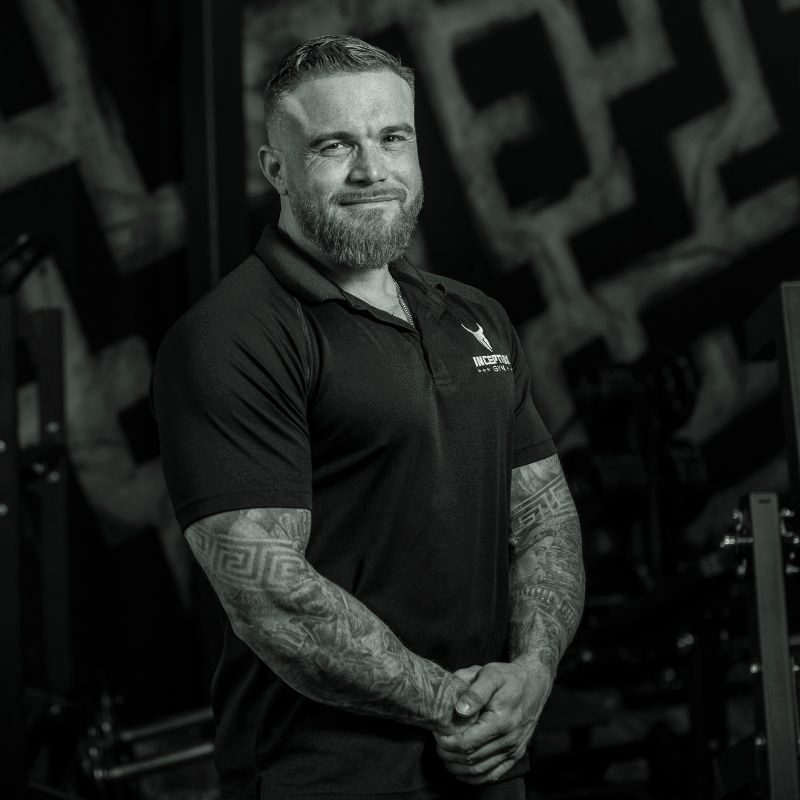

Yes, losing fat while building muscle is possible. Body recomposition describes that combined goal, but it is not an automatic result of eating more protein and lifting weights. 1
The practical task is to balance enough food for productive training with an intake that supports fat loss. Your starting point matters more than following a compulsory bulk-and-cut cycle.
Can you lose fat and build muscle at the same time?
In a four-week trial, 40 young men followed supplied diets with a large energy deficit and exercised six days weekly. Researchers compared 1.2 with 2.4 g of protein per kilogram of bodyweight daily. 1
The higher-protein group gained an average 1.2 kg of lean body mass while losing 4.8 kg of fat. This demonstrates possibility, not a realistic monthly promise for everyday coaching. 1
Lean body mass includes water and other non-fat tissues, not just skeletal muscle. The trial therefore cannot tell us that participants built 1.2 kg of muscle, or that its demanding programme suits everyone. 1
Who is most likely to benefit?
Beginners and people with more body fat are reasonable candidates. Evidence from untrained participants does not establish the same likelihood of success in lean, experienced lifters. 2
Returning lifters may regain previous adaptations, but muscle memory is not a guaranteed shortcut. A small human study found retained muscle-cell nuclei after detraining without clearly superior subsequent growth. 3
There is no universal 12 to 24-month beginner window. Nor does turning 30 determine whether to recompose. Consider training history, current intake, recovery and whether fat loss is appropriate.
For an experienced lifter whose main goal is adding size, a dedicated gaining phase may be more practical than continually trying to reduce fat. 2
The calorie band
Research finds that energy deficits reduce resistance-training gains in lean mass on average, even when strength improves. It does not identify one calorie deficit that works for every person. 4
If fat loss is appropriate, a 10 to 15% deficit can be a conservative starting experiment, not a scientifically validated recomposition window. Starting near maintenance is another option when rebuilding training is the priority.
For illustration, a 90 kg adult maintaining weight around 2,900 kcal would start around 2,465 to 2,610 kcal. A 70 kg adult maintaining around 2,100 kcal would start around 1,785 to 1,890 kcal.
Those maintenance figures are assumptions, not estimates derived from bodyweight alone. Compare your usual intake with your weight trend and activity over several weeks before treating a calculator result as settled.
Review hunger, training and recovery alongside measurements. If performance keeps deteriorating, reassess food intake and training load rather than automatically cutting more calories. These are practical checks, not diagnostic tests.
The protein target
Around 1.6 to 2.2 g/kg of bodyweight daily is a practical range. A major training meta-analysis estimated diminishing additional benefit around 1.6 g/kg, with considerable uncertainty. It excluded energy-restricted diets. 5
This is not a universal minimum or a special rule for adults over 30. During a deficit, choosing towards the upper end can be reasonable, but extra protein cannot guarantee muscle gain. 1 5
These figures use total bodyweight. Do not substitute fat-free mass into the same calculation. If bodyweight-based targets seem impractical, seek individual advice rather than changing the denominator yourself.
For example, 80 kg multiplied by 1.8 gives 144 g daily. Four meals averaging 36 g would meet that target. Three or four meals are an organisational option, not a requirement to maximise every meal’s response. 5
Build meals around options such as eggs, Greek yoghurt, lean mince, chicken thigh, tinned fish, cottage cheese or tofu. Check portions and labels; whey is optional when convenient.
Plant-only diets can support muscle gain. In a 12-week study, habitual vegan and omnivorous young men achieved similar training gains with protein matched around 1.6 g/kg daily. Both groups used supplements. 6
That was not a dieting trial, but it does not support a compulsory 2.2 g/kg vegan threshold. Plan substantial protein sources such as tofu, tempeh and legumes; soy or pea protein can be convenient additions. 6
For more detail, see protein for body composition.
The training stimulus and recovery
Progressive resistance training is the foundation. A workable framework is: 7
- Frequency: two or three sessions weekly, covering major muscle groups at least twice.
- Volume: build towards roughly 10 challenging sets per muscle weekly when appropriate. Beginners can start with fewer.
- Effort: finish many sets with about two or three good repetitions remaining. Failure is not compulsory.
- Progression: record repetitions and loads. Review a four to six-week block, adding difficulty when technique and recovery allow. 7
Use squat, hinge, press and pull variations, with carries or accessories where useful. Machines, free weights and bands can work. A circuit can qualify if its resistance and progression are sufficient. 7
Keep walking or Pilates if you enjoy them; assess the actual muscular challenge rather than dismissing an activity by name.
Aim for seven or more hours of sleep regularly, allowing for individual needs. This is general adult health guidance, not a hormone threshold or a guarantee of better muscle growth. 8
How it differs from a cut or a bulk
A cut prioritises fat loss. It should still aim to preserve muscle, not accept its loss as inevitable. More restriction can make simultaneous lean-mass gain harder. 4
A bulk prioritises gaining size, usually through a calorie surplus. Some fat gain may occur, but substantial fat gain is not a requirement. 2
Recomposition pursues both goals together. Choose it when that trade-off suits your priorities, rather than expecting maximal speed on either measure. A sensible programme can change phases; it need not mean dieting indefinitely.
How to tell whether it is working
Record training performance and combine it with waist measurements, optional photos and weight trends. Repeat measurements under similar conditions rather than reacting to one reading.
BIA estimates body composition; it does not directly measure muscle. Hydration affects results, so a small reported lean-mass increase cannot confirm muscle growth. 2
A smaller waist with improving performance is encouraging, not proof of a precise muscle gain. Stable weight alone is also inconclusive. See BIA versus DEXA for measurement context.
What to do this week
- Choose your priority: fat loss, rebuilding strength or pursuing both without a deadline.
- Work out a realistic protein target and plan meals that add up to it.
- Book your training sessions and record a starting load and repetition count.
- Take baseline measurements you are comfortable repeating. Schedule a review rather than chasing daily changes.
- Plan regular sleep time, including non-training nights.
For medical conditions, pregnancy or an eating-disorder history, agree any weight-loss and protein plan with your clinician or registered dietitian first.
If medication affects appetite or weight, involve your prescriber. Do not change medication to pursue recomposition. If restriction is harming your wellbeing or eating behaviour, seek support rather than tightening the target.