
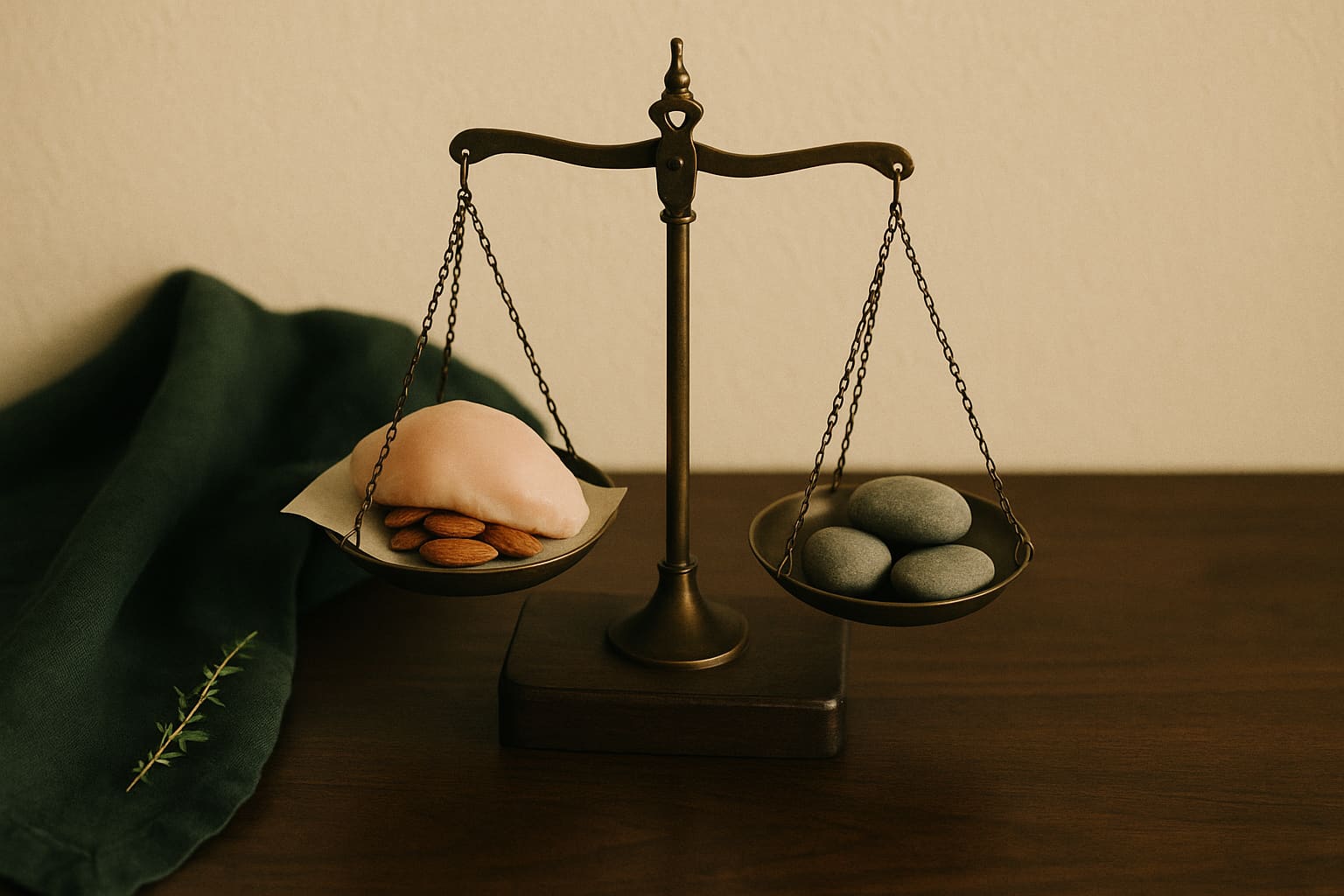
For healthy adults doing resistance training, 1.6 to 2.2 g of protein per kilogram of body weight daily is a useful planning range. It is not a compulsory minimum or a guarantee of muscle gain. 1
The key correction is the denominator: this range uses body weight, not lean body mass. Your training, energy intake, health and ability to follow the plan still matter.
Body weight or lean body mass: use the right denominator
A protein target only makes sense when its multiplier matches the research. You cannot take a body-weight recommendation and apply the same number to fat-free mass. 1
For example, a 100 kg person estimated at 30 per cent body fat has about 70 kg of fat-free mass. Multiplying 100 kg by 1.6 to 2.2 gives 160 to 220 g daily. Multiplying 70 kg gives 112 to 154 g.
Those are different prescriptions, not two ways of calculating the same thing. The arithmetic does not establish which target is appropriate for that individual.
Fat-free mass includes water, organs, bone and other tissues, not just skeletal muscle. A body composition estimate therefore cannot be read as a direct measure of muscle or its protein requirements. 10
If you carry substantial excess body fat, do not automatically select the highest body-weight target. Ask a dietitian to help choose a realistic target rather than switching denominators yourself.
The NZ baseline also needs context. For adults aged 19 to 70, the Australia and New Zealand protein RDIs are 0.84 g/kg for men and 0.75 g/kg for women. Values are higher after 70. 2
These reference values address nutritional adequacy. They are not a universal deficiency boundary, nor a specific prescription for maximising resistance-training adaptations. 2
For broader requirements outside body composition goals, see how much protein do I actually need.
The protein range, unpacked by goal
A major resistance-training meta-analysis estimated a breakpoint near 1.6 g/kg/day. Its upper confidence limit was 2.2 g/kg/day. That uncertainty is why a planning range is more useful than one supposedly exact number. 1
Muscle gain: start around the lower end and review the whole training and eating plan before adding more protein. The analysis does not establish that everyone needs the upper end. 1
Fat loss: higher intakes may help retain lean tissue during energy restriction. AIS guidance gives athletes undertaking weight loss a range of 1.6 to 2.4 g/kg of body weight daily. 4
In one four-week trial, young men eating 2.4 rather than 1.2 g/kg/day gained more lean mass and lost more fat during a large energy deficit with intensive exercise. 3
That demanding protocol is not a recommendation to copy the diet or training load. It does not establish an exact requirement for women, older adults or everyday fat-loss programmes. 3
Recomposition: the same trial shows that losing fat while gaining lean mass can occur. It does not mean a particular protein intake guarantees both, or that every kilogram of lean gain is muscle. 3
Choose a manageable target within the relevant range, then assess the result. Avoid treating tiny differences between proposed maintenance, recomposition and fat-loss targets as established science.
If your target makes meals unpleasant, expensive or difficult to sustain, review it. Do not force the highest number simply because it appears at the top of a range.
For the training and energy-intake context, see body recomposition.
Distribution across meals: useful, not a leucine test
Spreading protein across three to five eating occasions is a reasonable approach. AIS guidance suggests approximately 0.3 to 0.4 g/kg per occasion, adjusted to the daily target. 4
For an illustrative 140 g daily target, you could plan:
- Breakfast: 35 g.
- Lunch: 40 g.
- Dinner: 40 g.
- A snack: 25 g.
Four portions of 35 g would also work as a planning structure. Exact equality is unnecessary. Start with the meal that currently has the least protein rather than redesigning everything at once.
Leucine helps signal muscle protein synthesis, but the other essential amino acids provide necessary building material. Protein sources differ in their amino acid content. 4 6
There is no single leucine number that certifies every mixed meal as maximally muscle-building. Laboratory estimates depend on the participants and protein tested. 5
Treat meal distribution as a practical tool, not proof that a large dinner is wasted or that a smaller breakfast fails. Acute protein synthesis findings do not establish those long-term outcomes. 5
Try planning breakfast and lunch before shopping. If dinner already supplies plenty, move some of your protein budget earlier instead of automatically adding another shake.
Anabolic resistance: ageing without an age-40 rule
Older adults can have a smaller muscle protein synthesis response to a given protein serving. This is often called anabolic resistance. 5
An analysis comparing men averaging about 71 and 22 years estimated a higher relative protein dose in the older group, around 0.4 g/kg per meal. The estimates had substantial uncertainty. 5
For a 70 kg person, 0.4 g/kg is 28 g. That calculation alone shows why a compulsory 40 g floor for everyone is inappropriate.
The study measured short-term responses, not the effects of crossing your fortieth birthday. It does not prove that all adults over 40 need the same meal size or that larger servings resolve stalled progress. 5
As a practical check, review breakfast, lunch and your daily total together. If a large portion is uncomfortable, consider a smaller meal and a later snack rather than forcing it.
For wider meal-planning considerations, see how to eat after 40.
Protein quality and bioavailability
Protein quality describes how well a source supplies digestible essential amino acids. DIAAS, the Digestible Indispensable Amino Acid Score, is an FAO-recommended assessment method. 6
It is not a score for overall food quality or a direct prediction of muscle growth. A single ingredient's score also does not describe an entire mixed diet. 6
Milk, eggs, meat and fish provide useful essential amino acid profiles. Plant proteins vary, and a limiting amino acid means relatively little of that amino acid, not necessarily none. 6
Combining sources can improve the overall profile. Rice with beans and hummus with pita are practical examples of cereal-and-legume combinations. 6
Count protein from plant foods towards your intake. There is no need to delete bread, beans or nuts from your tally because they are not whey. Consider the variety and amounts across the diet. 6
In a 12-week study, vegan and omnivorous young men consuming approximately 1.6 g/kg/day had similar observed improvements in muscle measurements and strength during training. 7
The study was small, involved previously untrained men and used soy or whey supplements. It supports the feasibility of a well-planned vegan approach, not equivalence between every food or diet. 7
For plant-based meals, try tofu stir-fry, tempeh wraps, edamame bowls or lentil dishes. Check the amount your usual portion supplies before assuming a meal reaches your target.
Practical NZ protein sources
Use these as approximate starting points, not fixed values for every product. The NZ food composition tables show meaningful variation with preparation and food type. 8
| Food | Approximate protein |
|---|---|
| Two standard-to-large boiled eggs | 13 to 14 g |
| Milk, 250 mL | About 9 g |
| Cottage cheese, 100 g | About 11 to 14 g |
| Grilled chicken breast, 100 g cooked | About 31 g |
| Roasted chicken thigh, 100 g flesh | About 23 g |
| Tempeh, 100 g | About 19 to 21 g |
These rounded examples come from the NZ tables. Check current labels for packaged versions. 8
Other meal options include beef mince, lamb, hoki, tarakihi, salmon, tofu and lentils. Choose according to preference, preparation time and your actual supermarket prices.
For yoghurt, read the label rather than assuming that “Greek” means a particular protein content. The tables themselves include a Greek yoghurt with only 5 g per 100 g. 8
For example, a yoghurt labelled 8 g per 100 g provides 20 g in a 250 g portion. This is label arithmetic, not a claim about all yoghurt.
Keep raw and cooked weights separate when logging food. Select the matching database entry rather than using a cooked-food value for a raw portion. 8
For cost comparisons, divide the pack price by the total grams of protein in the pack, then multiply by 20. This gives a comparable cost per 20 g of protein.
Also consider food waste, convenience and what you enjoy. A slightly cheaper option is not useful if it regularly goes uneaten.
When supplementing is sensible
A supplement can fill a gap when appetite, travel, shift work or food preparation makes meals difficult. It is optional, not something you automatically need after reaching a particular daily target. 4
Start by identifying the gap. Is breakfast missing protein, is lunch unpredictable, or does your planned total exceed what you comfortably eat? Solve that specific problem.
Whey, casein, soy or plant blends are options. Casein digests more slowly, but evidence does not establish that it is uniquely superior at bedtime. 4
Compare grams of protein per serving, price, ingredients and tolerance. A scoop measures powder, not pure protein, and serving sizes differ. 4
Collagen still contributes protein, but it is not an interchangeable muscle-focused substitute. In older women, whey produced greater muscle protein synthesis responses than collagen. 9
That study does not settle every proposed use of collagen or demonstrate months-long differences in muscle gain. Avoid making it your main protein source for this goal. 9
See does collagen protein actually work for the separate collagen discussion.
If you take a GLP-1 medicine and struggle to eat enough, discuss this with your prescriber and a dietitian. A protein shake should not be your only response to persistent difficulty eating.
Monitor progress without making a scan compulsory
You do not need a scan to begin using a body-weight-based target. BIA can add context, but it estimates composition from electrical measurements and prediction methods. 10
A study of fifteen devices found that accuracy and the ability to track change varied substantially. Consistent-looking readings did not necessarily mean accurate readings. 10
If you scan, use the same device and comparable preparation conditions. Follow its protocol for meals, fluids and recent exercise rather than treating differently prepared readings as directly comparable. 10
A small change in estimated lean mass does not prove muscle gain or loss, and a monthly scan cannot establish that protein caused the result. 10
Use a simple review process alongside any scan:
- Record several representative days of eating, including a weekend day. Include all protein sources and check portions.
- Identify recurring gaps rather than judging yourself on one unusual day.
- Keep notes on training performance, body-weight trend, waist measurement, appetite and recovery.
- Review the whole plan before increasing protein. Ask whether meals, training and the intended energy intake are actually consistent.
Aim for a repeatable daily pattern, not perfect compliance. If one day goes off plan, return to your usual meals rather than compensating with an oversized protein day.
For measurement detail, see the body composition scanning guide.
If you have kidney disease, seek individual advice before adopting a high-protein target. Requirements differ with disease stage and treatment, including dialysis. 11
Persistent poor intake, unintended weight loss or declining strength also deserve assessment by your GP or a dietitian, rather than repeated changes to a protein number.
If you want help turning a target into meals that fit your routine, enquire about nutrition coaching.