Protecting bone after fifty takes more than a protein target. Adequate food, suitable exercise and assessment of fracture risk all matter. There is no single intake that guarantees protection.
What changes around menopause
Bone is living tissue. Osteoclasts remove old bone and osteoblasts replace it. Falling oestrogen around menopause can shift that balance towards greater loss. 1
Loss can accelerate around menopause and the early post-menopausal years, but its timing and extent vary. Turning fifty does not mean everyone needs the same diet, exercise programme or scan schedule. 1
Bone is not just calcium. It contains a collagen protein framework reinforced with mineral. Dietary protein supplies amino acids for that framework, but extra protein does not automatically build stronger bone. 1
Setting a useful protein target
The Australia and New Zealand protein RDI for women is 0.75 g/kg of bodyweight daily at ages 51–70, rising to 0.94 g/kg after 70. These are population reference values, not personalised training targets. 2
Older-adult nutrition guidance commonly suggests about 1.0–1.2 g/kg/day. For a 65 kg woman, that is 65–78 g daily. This is general nutrition guidance, not a proven dose for preventing osteoporosis. 3
Needs may rise with resistance training, illness or recovery. This guidance does not automatically apply to every woman over fifty. A personal target should account for activity, health and nutritional status. 3
In a two-year trial, 219 women aged 70–80 received either 30 g whey protein or a low-protein control drink daily. Both drinks contained calcium. Extra whey did not improve hip bone-density outcomes. 4
Their starting protein intake averaged 1.1 g/kg/day. That limits what the trial tells us about correcting genuinely low intake, but it does not support treating more protein as automatically better for bone. 4
A useful starting point is to record three ordinary days of eating. Weigh food portions if helpful, then use labels to calculate protein grams. The weight of a food is not its protein content.
Spread protein-containing foods across meals rather than relying on dinner. If you have kidney disease or another condition affecting your diet, ask your treating clinician or dietitian to individualise the target.
Load is the other half
Keep walking and add progressive resistance and suitable impact for bone strength. Balance training addresses another important part of fracture prevention: falls. 5
Aim for resistance work on two or three days weekly, starting at a manageable level. Increase resistance as technique and confidence improve. 5
Useful movement patterns include squats or sit-to-stands, hip hinges, presses and rows. The programme should challenge the relevant muscles safely, rather than insist on one piece of equipment. 5
The LIFTMOR trial tested supervised, twice-weekly resistance and impact training in 101 post-menopausal women with low bone mass over eight months. 6
The training group improved spine bone density and better maintained femoral-neck density than controls. This was a small, closely supervised trial, not proof of fracture prevention or unsupervised safety. 6
Jumps, hops or skipping may suit some women. After vertebral or multiple low-trauma fractures, get personalised physiotherapy advice before increasing impact. Joint comfort alone is not the safety check. 5
Pilates and yoga can contribute to balance and strength. Keep activities you enjoy, while checking whether the overall programme includes progressive loading. 5
For practical programming, see strength training for women over fifty.
The labs and scans worth discussing
DXA, also called DEXA, measures bone mineral density, usually at the hip and spine. It helps assess fracture risk, but the result belongs alongside your medical and fracture history. 7
NZ guidance includes DXA for women under 65 with risk factors, and women aged 65 or older considering osteoporosis prevention. A low-trauma fracture is a reason for assessment without waiting for a birthday. 7
Discuss previous fractures, low bodyweight, family history and medicines such as long-term glucocorticoids. Your GP can assess whether a scan would change your care. 7
There is no universal menopause scanning interval. Repeat timing depends on baseline density, treatment and factors affecting bone loss. Stable, lower-risk women may not need frequent scans. 8
Use the same facility where possible. Small differences may reflect measurement variation; ask whether a change exceeds the facility's least significant change, rather than comparing T-scores alone. 8
Blood tests investigate possible contributors, not bone density itself. In suspected osteoporosis, a clinician may check calcium, renal function, alkaline phosphatase, thyroid function and 25-OH vitamin D. 9
PTH and magnesium are selective tests. CTX reflects bone resorption and P1NP bone formation; these markers are mainly useful in selected treatment-monitoring situations, not as a routine wellness panel. 9
What BIA can and cannot tell you
BIA estimates body composition from electrical impedance. Hydration changes can distort those estimates, so a reported change in lean mass is not necessarily a change in skeletal muscle. 10
It does not measure bone density and cannot establish whether your bones are improving between DXA appointments. A falling lean-mass estimate is not proof of simultaneous bone loss. 8 10
Track training progress and physical function for their own value. Do not use a body-composition score as a substitute for fracture-risk assessment.
See how to read a body composition scan for the separate question of tracking fat and lean-mass estimates.
Where the everyday plan can fall short
Breakfast is an opportunity, not a test you pass or fail. For example, a daily target of 75–90 g could be divided into three meals supplying roughly 25–30 g each. That is meal-planning arithmetic, not a biological threshold.
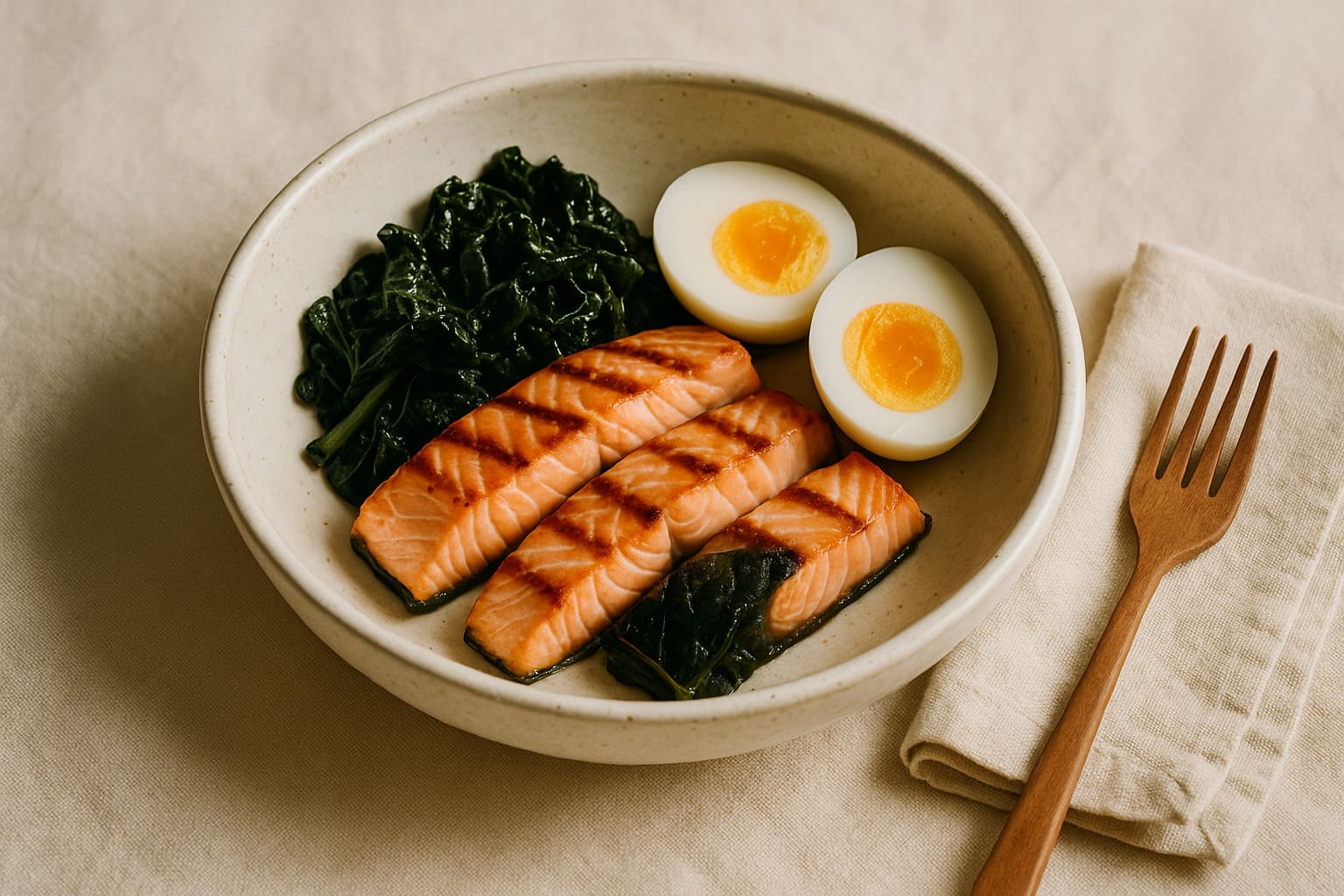
Try eggs with yoghurt, cottage cheese on toast, or a tofu-based meal. Check the actual portions and labels rather than assuming any serving supplies 30 g. A shake is an option, not a requirement.
Keep calcium-rich foods in the plan too: milk, yoghurt, calcium-fortified alternatives and canned fish with edible bones. Protein does not replace calcium or vitamin D. 1
Avoid making the diet so restrictive that overall intake becomes inadequate. Protein guidance assumes enough energy is available as well. 3
Menopausal hormone therapy can help protect bone in appropriately selected women. Suitability depends on symptoms, age, time since menopause and individual risks, so discuss it with your GP. 9
Nutrition and exercise support care; they do not replace osteoporosis treatment when it is indicated. 9
What to do this week
- Record three normal days of food, then identify one meal where a protein-containing food would help.
- Schedule two manageable resistance sessions, with instruction if the movements are new.
- Keep walking and include balance practice appropriate to your ability.
- Write down fracture history, relevant medicines and family history before a GP discussion about bone risk.
- Ask what any proposed scan or blood test would change, and when reassessment would be useful.
Seek medical assessment after a fracture from a minor fall, or for new severe back pain or unexplained height loss. These can warrant investigation rather than simply changing your diet or training. 1