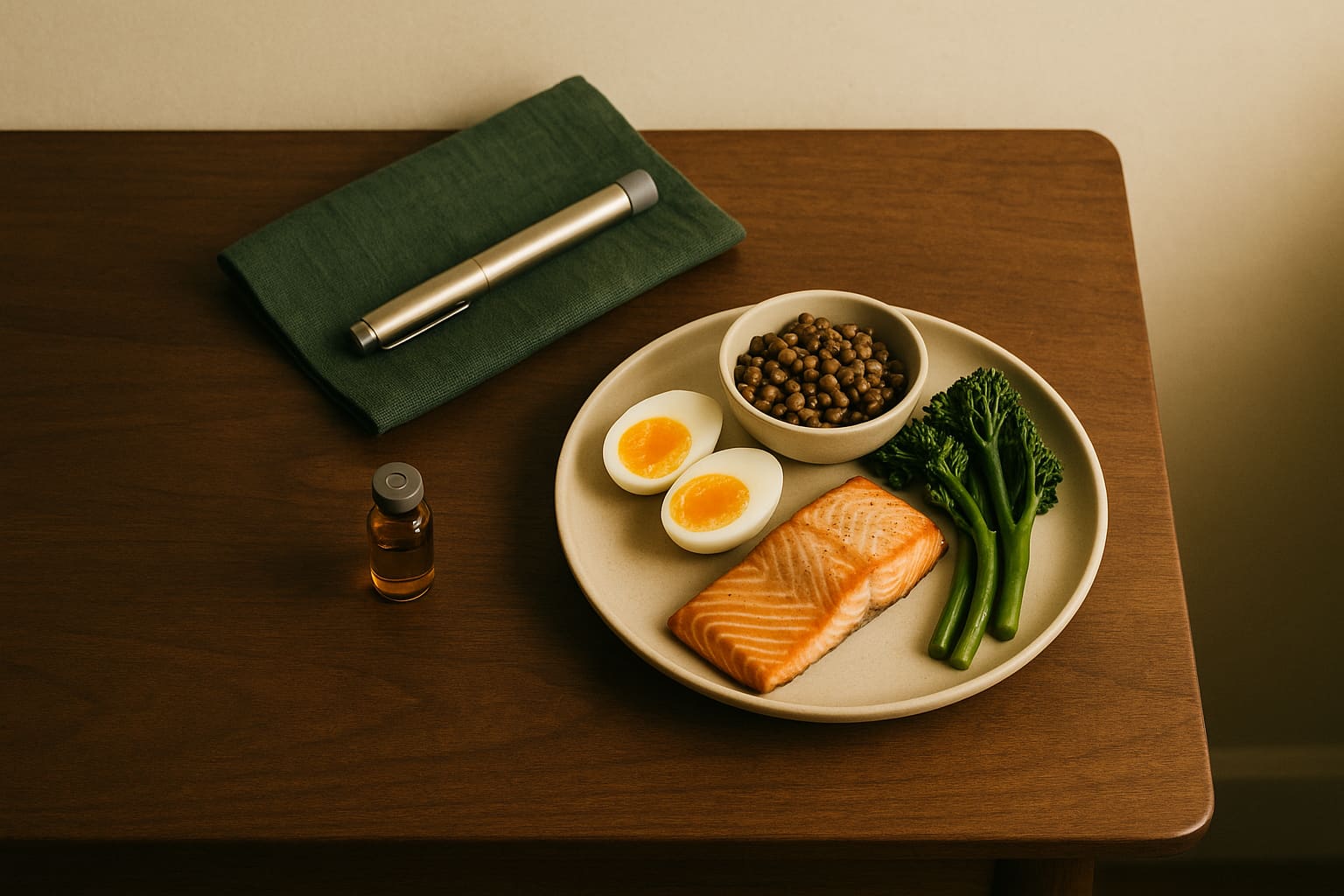
A GLP-1 prescription and a nutrition strategy do different jobs. Treatment can support weight loss; nutrition planning helps address adequate intake, strength and changing food tolerance. 1
The goal is not simply to eat less. It is to make a smaller appetite workable without treating every lost kilogram as an equally useful outcome.
The Muscle Loss Problem, in Context
Weight loss can include both fat and lean tissue. Lean mass is not skeletal muscle: it also includes water, organs and other tissues. A decline does not automatically mean equivalent muscle loss. 1
In the 2021 STEP 1 exploratory DXA substudy, 140 participants were assessed over 68 weeks. The semaglutide group lost about 15% of bodyweight. 2
Total fat mass fell 19.3% and lean mass 9.7% from their respective starting values. These are not percentages of the weight lost. Lean mass became a larger proportion of the smaller body. 2
The 2025 SURMOUNT-1 analysis included 160 people with paired scans. Around 75% of weight lost was fat and 25% lean mass in both tirzepatide and placebo groups. Tirzepatide also acts on GIP receptors. 3
That finding does not establish a universal ratio or prove identical muscle effects across medicines. Neither substudy supports predicting that someone losing 15 kg will lose 5.8 kg of muscle. 2 3
Why General Dietary Advice Needs a Practical Plan
Appetite suppression can make meals smaller or easier to skip. Advice therefore needs to cover what you can eat consistently, not just what to reduce. 1
Start by recording a few ordinary days: meals, drinks, symptoms and activity. Bring that record to a nutrition review rather than assuming your current intake is adequate because weight is falling. 4
Agree on priorities that fit your budget, food preferences and medical history. The plan should be specific enough to use on a busy day, without requiring perfect tracking. 1
Protein Requirements During GLP-1 Use
Guidance commonly discusses 1.2 to 1.6 g of protein per kilogram of bodyweight daily during weight loss. This is not a validated GLP-1-specific dose or a muscle-preservation guarantee. 4
With obesity, actual bodyweight can overestimate requirements. There is no agreed best denominator for everyone: adjusted weight and fat-free mass involve different calculations. 4
The joint advisory also discusses 80 to 120 g daily as a practical option. Treat this as a starting point for assessment, not a universal prescription. 4
Kidney disease and other clinical circumstances may require different advice. Agree on a daily amount with your clinician or dietitian rather than converting a scan result into a precise requirement. 1
For illustration, an agreed 100 g target could be divided into three meals of 25 g plus a 25 g snack. That is planning arithmetic, not a proven optimal meal schedule.
Make Smaller Meals Nutritionally Useful
Use these as adaptable meal-building ideas, not a fixed menu:
- Breakfast: Greek yoghurt with oats and fruit.
- Lunch: a chicken or bean wrap with vegetables.
- Dinner: fish or lentils with rice and vegetables.
- A smaller option: yoghurt or a suitable nutrition drink when a full meal is difficult.
The principles are protein, dietary variety and manageable portions. Keep fruit, vegetables and other nutrient-rich foods in the plan rather than letting protein displace everything else. 5
If nausea is an issue, try smaller portions, eat slowly and note foods that worsen symptoms. Maintain fluids and adjust fibre to tolerance rather than forcing large servings. 5
A written fallback meal is useful: decide what you will eat when your usual lunch feels unmanageable. Review persistent gaps instead of relying on supplements to repair an inadequate diet.
How Personalised Nutrition Can Support Outcomes
Protein should sit alongside resistance training, not replace it. Choose a progressive programme suited to your strength, mobility and recovery. 4
Exercise during GLP-1 treatment has been tested. A 2021 trial randomised 195 adults, after initial diet-induced weight loss, to exercise, liraglutide, both or placebo for one year. 6
The combined group reduced body-fat percentage more than either active treatment alone. This supports including exercise, but it was not a trial of semaglutide, tirzepatide or a particular protein target. 6
STEP 1 included lifestyle intervention in both arms. It cannot tell us how much extra benefit an individual coaching service provides. Claims of a precise muscle-preservation percentage need separate evidence. 2
For more on this specific goal, see preserving muscle during GLP-1 use.
The Role of Body Composition Monitoring
BIA uses electrical impedance and prediction equations to estimate body composition. Its outputs should not be treated as direct measurements of muscle, visceral fat or metabolic rate. 7
Results depend on measurement conditions and the device. In a small comparison with DXA, agreement varied with posture and waist circumference, illustrating why estimates need context. 7
If you use BIA, keep the device and testing conditions consistent. Do not treat a single change as proof of muscle gain or loss, or compare different methods as though they were interchangeable. 7
Review weight and waist trends alongside food intake, symptoms and strength or function. A clinician may use measures such as chair-rise performance or grip strength when appropriate. 1
Ask a useful question at each review: can you follow the plan, tolerate your meals and maintain everyday capability? A scan is one input, not the verdict.
When Nutrition Advice Is Not Enough
Contact your prescriber if vomiting, diarrhoea or difficulty eating persists. GLP-1 gastrointestinal effects can cause dehydration and in rare cases worsen kidney function. 8
Seek urgent medical assessment for severe, persistent abdominal pain, particularly with vomiting, or if you cannot keep fluids down. Do not assume these symptoms need only a meal-plan adjustment. 8
Medication decisions belong with your prescriber. Nutrition coaching can complement medical care, not replace it.
If you would like help turning these priorities into a workable routine, explore nutrition coaching. You do not need to wait for a scan to begin discussing your meals and goals.